
Most couples walk into a venue tour trying to answer one big question:
Can we actually picture ourselves getting married here?
Most venues approach the tour hoping the property answers the question on its own.
That sounds straightforward enough until you look at what happens afterward for a lot of venues. The tour goes well. The couple seems excited. They ask thoughtful wedding venue tour questions, take photos around the property, request pricing, and leave saying they will talk things over.
Then the follow-up drifts.
A week passes. Then two. The venue sends another email. The couple responds politely, says they are still deciding, and eventually disappears altogether.
Many venue owners assume this is simply part of the business. In reality, a large percentage of those situations come down to one thing: the venue never truly understood where the couple stood in the buying process during the tour itself.
Inside Fully Booked Venue’s client portfolio, we started noticing a consistent pattern among venues that booked faster and followed up more effectively. Their tours felt conversational and relaxed on the surface, but underneath the conversation was a clear qualification process helping them uncover buying intent in real time.
That process became the foundation for the FBV Tour Discovery Framework.
The FBV Tour Discovery Framework: The Four Buyer-Readiness Levels

The framework itself is simple.
There should be seven core questions woven naturally throughout the tour conversation. Each one helps uncover a different buyer-readiness signal that influences how likely a couple is to move forward.
The key is recognizing which stage a couple is actually in while the conversation is happening. Let’s dig in to each one a little deeper, so you will have the ability to reconize them when you see it:
Passive Exploration
These couples are still early in the process. Their timelines are usually broad, budgets feel less defined, and they often mention several other venues they still plan to tour.
Conversations at this stage tend to stay exploratory rather than decisive. Follow-up works better when it focuses on education, reassurance, and helping the couple continue organizing their decision-making process.
Active Comparison
At this stage, couples have started narrowing their options.
You will usually notice more direct pricing questions, stronger comparisons between venues, and clearer conversations around logistics and priorities. This is where positioning becomes increasingly important because the couple is no longer asking, “What venues exist?” They are asking, “Which venue fits us best?”
That distinction heavily shapes how venues should approach a bride across every stage of the sales process.
Intent-Led Evaluation
This stage feels noticeably different during tours.
Couples begin imagining themselves inside the experience rather than simply evaluating the property. Conversations shift toward guest flow, emotional atmosphere, family involvement, and what the wedding day could realistically feel like.
The venue starts becoming emotionally real to them.
Contract-Ready
These conversations naturally move toward next steps.
Questions start focusing on deposits, timing, contract logistics, and date protection. Momentum already exists during the tour itself, which means slow or generic follow-up can create unnecessary delays.
The more venue teams recognize these buyer-readiness patterns in real time, the easier it becomes to guide conversations intentionally instead of reacting passively throughout the tour.
The 7 Questions Inside the FBV Tour Discovery Framework
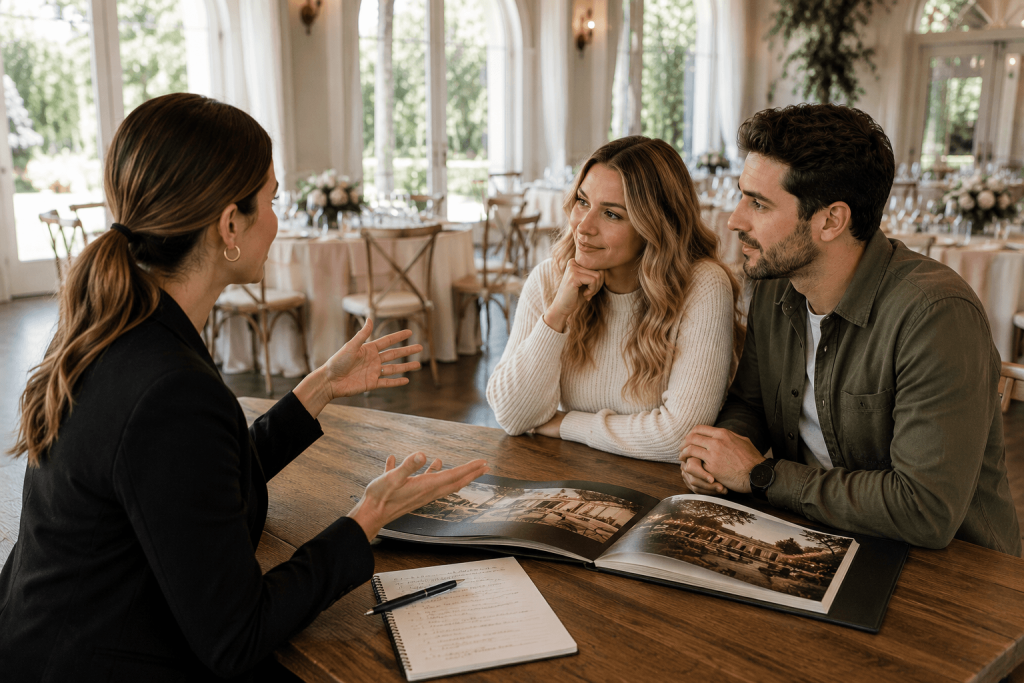
The strongest venue managers naturally blend discovery into the walkthrough itself. They respond thoughtfully to answers, leave room for conversation to develop organically, and avoid rushing from one talking point to the next.
None of these questions work if the conversation feels scripted.
Couples remember how the interaction felt just as much as they remember the property.
1. “What made you decide to start touring venues right now?”
This question uncovers timeline pressure immediately.
A couple saying:
“We realized dates were disappearing faster than we expected.”
…is operating very differently from a couple casually exploring venues for a wedding that may happen sometime next year.
That context matters because urgency shapes everything from follow-up timing to how emotionally committed the couple already feels to making progress.
2. “Who else will be involved when you make the final decision?”
This is one of the most important questions many venues skip entirely.
It surfaces decision-maker involvement early before follow-up complications appear later.
A surprising number of tours end without the venue realizing parents are funding the wedding, another family member strongly influences the decision, or the couple cannot finalize things independently. After all, about 50% to 60% of couples receive financial support from their parents for their wedding, with parents typically contributing around half of the total budget.
Once those dynamics become clear, communication becomes far easier to tailor appropriately.
Sometimes the couple needs detailed pricing summaries for family review. Other times they need reassurance around flexibility, logistics, or overall value.
A large amount of post-tour silence is often internal family alignment happening behind the scenes.
3. “What other venues have stood out to you so far?”
This question reveals the comparison set the venue is operating inside.
For example, a couple might say:
“We’ve toured a few barn venues already, but they all felt more rustic than what we want.”
That single answer immediately tells the venue what aesthetic direction the couple prefers, what frustrations already exist, how previous tours felt, and what positioning gaps still remain open.
The rest of the conversation becomes much easier to personalize once that context appears.
4. “What part of the wedding matters most to you personally?”
Every couple has an emotional anchor, even if they have not fully articulated it yet.
For some couples it is guest experience. For others it is intimacy, atmosphere, aesthetics, convenience, or family traditions.
Once the venue manager understands what emotionally matters most, the walkthrough itself becomes more meaningful because the property can be framed through that lens instead of through generic feature explanations.
This is usually where tours start feeling more memorable.
5. “How flexible are you on your date if the right venue became available?”
This question often reveals how emotionally attached the couple already feels toward the venue experience itself.
Couples willing to shift dates slightly are frequently more venue-focused and more invested in finding the right fit overall. Couples locked into one highly specific date often stay in heavier comparison mode because availability restrictions create more pressure.
The answer helps venues forecast both urgency and realistic booking probability.
6. “What concerns still feel unresolved for you right now?”
Most objections do not suddenly appear after the tour.
They already exist during the conversation.
This question simply creates space for the couple to voice them earlier.
Sometimes the concern involves hidden fees. Other times it involves vendor flexibility, guest count uncertainty, weather backup plans, or overall planning stress.
When those concerns surface naturally during the tour, the venue has an opportunity to address them while emotional momentum still exists.
That usually creates far more effective follow-up afterward because the venue already understands what reassurance matters most.
7. “What would need to happen after today for you to feel comfortable moving forward?”
This question clarifies closing readiness.
Some couples simply need a night to review numbers together. Others still have several venue tours remaining before they feel comfortable narrowing the list further.
Those are completely different situations operationally.
One may require fast, highly personalized follow-up while the other benefits from slower relationship-building and educational nurture.
Without this question, many venues end up guessing.
All these questions matter because venue ownership already comes with enormous operational pressure behind the scenes. Managing inquiries, tours, vendors, timelines, staffing, and emotional expectations simultaneously is part of owning a wedding venue becomes far more demanding than most outsiders realize.
Where the Tour Fits Inside Your Larger Marketing System
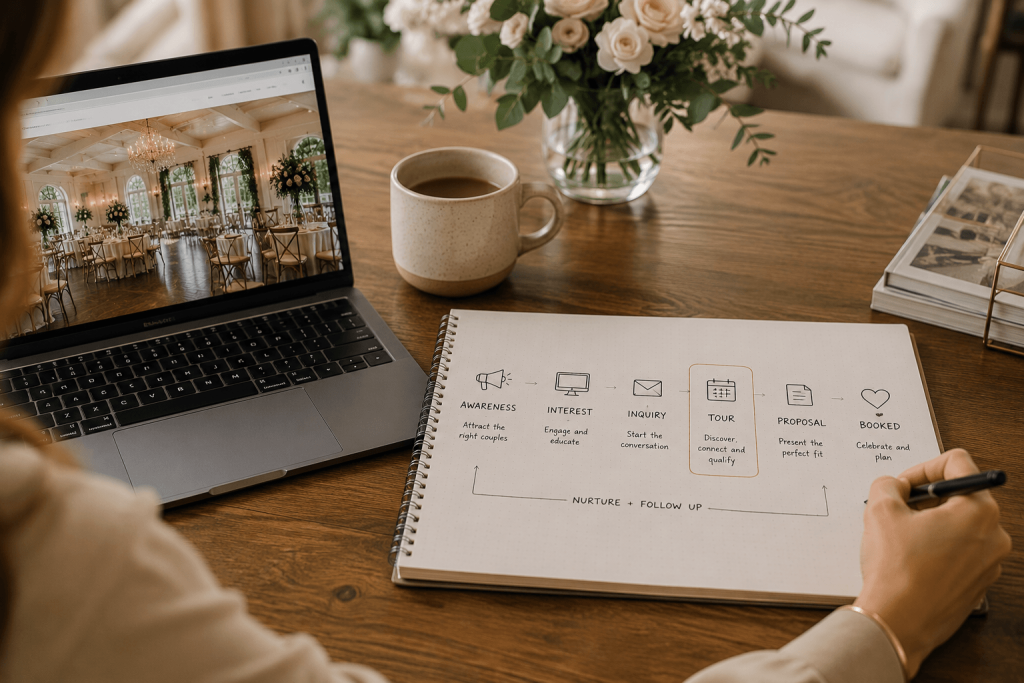
As you may know. tours are not isolated events.
They sit in the middle of the larger booking journey. A couple discovers the venue through marketing, submits an inquiry, moves through the nurture process, schedules a tour, evaluates their options afterward, and eventually decides whether to move forward with a contract.
That entire journey is connected.
In almost every intake call we have with a venue owner, the conversation lands in the same place: plenty of inquiries, not enough conversions. The issue isn’t the top of the funnel. It’s everything between the inquiry and the contract.
FBV helps wedding venues build systems around the entire booking process, including lead generation, inquiry handling, nurture strategy, tours, follow-up, and conversion optimization. The goal is helping venues create a process that turns more of the right inquiries into booked dates.
Get the Full FBV Tour Discovery Framework
The FBV Tour Discovery questions covered here is only part of the larger system FBV uses to help venues improve tour-to-contract conversion rates.
Inside the full framework, we break down how to structure tours from the first few minutes of the conversation through post-tour follow-up, including how to identify buying signals earlier, handle common objections more naturally, improve tour pacing, and build follow-up sequences based on actual buyer readiness instead of generic templates.
If you want the full FBV Tour Discovery Script, including real-world examples, follow-up structure, readiness scoring, objection handling guidance, and the systems venues use to shorten time-to-contract, jump on a strategy call with us.
Key Takeaways
- Strong venue tours uncover buying intent, not just logistical preferences.
- The FBV Tour Discovery Framework helps venues recognize four buyer-readiness stages and adjust follow-up accordingly.
- The seven discovery questions are designed to surface signals like urgency, emotional investment, comparison behavior, and contract readiness.
- Couples’ logistical questions often reveal deeper concerns around budget, control, risk, and decision-making confidence.
- Venues that consistently improve tour-to-contract conversion rates usually treat tours as part of a larger booking system rather than isolated walkthroughs.
Frequently Asked Questions
What is the 50-30-20 rule for weddings?
The 50-30-20 rule is a budgeting approach many couples use while touring wedding venues and comparing pricing at each wedding venue they visit. In most cases, around 50% of the budget goes toward the wedding venue, catering, rentals, and the reception venue itself, while 30% covers photography, attire, entertainment, and the wedding cake.
The remaining 20% is usually reserved for additional fees, gratuities, or last-minute changes that appear closer to the wedding day. During a wedding venue tour, couples should ask questions to ask about the rental fee, venue fee, payment plan, and whether the wedding venue includes an in house caterer or allows own alcohol with a corkage fee.
What is the 30-5 rule for weddings?
The 30-5 rule refers to how many couples narrow down options while touring wedding venues. A couple may start with 30 online options, reduce the list to 5 serious contenders, and then schedule a private tour or venue tour at each wedding venue before making an informed decision.
During the venue tour, couples often focus on guest count flexibility, whether the space accommodate their bridal party, and how the ceremony and reception flow throughout the entire event. A strong venue manager will also explain how the wedding venue handles inclement weather, whether there is a backup plan for outdoor spaces, and how venue staff coordinate the cocktail hour and transition into the wedding day schedule.
What is the rarest month to get married?
January is usually considered the rarest month for weddings in the United States, although some wedding venue owners see smaller spikes around February as well. Many couples avoid winter because of travel concerns for out of town guests, weather risks, and uncertainty around outdoor spaces during a venue tour.
Still, some couples specifically choose an off-season wedding venue because it can lower the rental fee, reduce additional fees, and improve flexibility around a specific wedding date. During a site tour, couples should ask questions to ask about heating, indoor ceremony and reception layouts, and whether the wedding venue has a reliable backup plan if weather conditions shift unexpectedly near the wedding day.
What are good questions to ask at a wedding venue tour?
Good questions to ask during a wedding venue tour usually focus on logistics, flexibility, and how the wedding venue operates behind the scenes. Couples should ask whether the wedding venue can venue accommodate their guest count comfortably, whether outside vendors or own vendors are allowed, and whether the venue manager provides a preferred vendor list.
Other important questions to ask during a venue tour include whether there is a bridal suite, dedicated dance floor, liquor license, cake cutting fee, or restrictions around own decorations. Couples should also ask how many weddings happen per day, how venue staff support the wedding party, and how the venue coordinator handles timeline management throughout the wedding day.
What questions should you ask when choosing a wedding venue?
When choosing a wedding venue, couples should ask questions to ask that help clarify pricing, logistics, and overall fit. A venue tour should include conversations about preferred vendors, parking, setup timing, cocktail hour flow, and whether the space accommodate the expected guest count without feeling crowded. Couples should also ask the venue manager how the wedding venue handles vendor access, timeline changes, and communication leading into the wedding day itself.
During a wedding venue tour, it is also helpful to ask whether the wedding venue has restrictions around alcohol service, whether couples can bring own alcohol, and how the venue coordinator manages transitions between the ceremony and reception so the entire event feels organized from start to finish.