

Most “Knot alternatives” lists name other directories. That is the wrong category. The wedding venues that genuinely left The Knot did not switch to another directory; they built a channel mix that captured the same buying intent without the shared-marketplace model. Every couple comes only to them. No fixed contract. No 12-month renewal.
Here is the mix, the mechanism behind each channel, the 30-day plan for transitioning without losing inquiry volume, and the honest cases where The Knot is still the right call.
Why a directory swap is not the answer
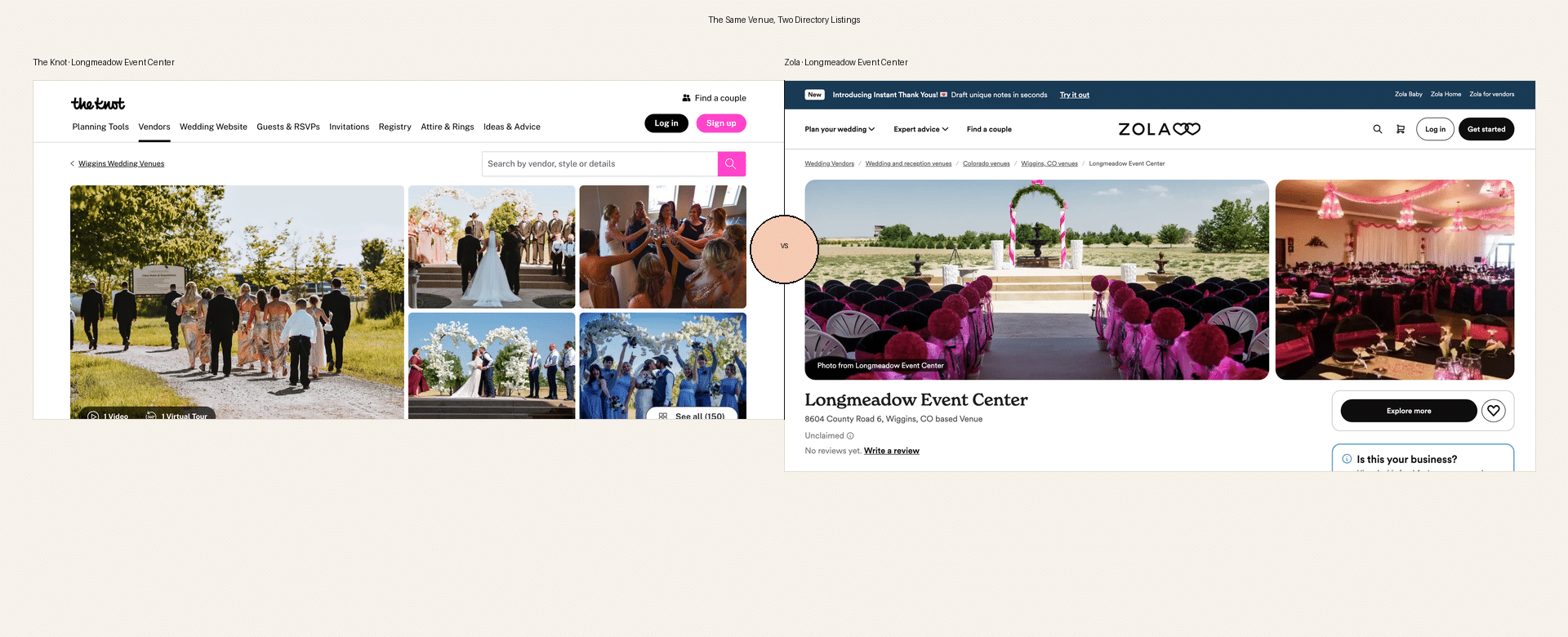
The Knot, WeddingWire, Zola, and the regional knock-offs all share one model: you pay for placement in a shared marketplace, couples browse, and the platform sends the same inquiry to your venue alongside the venues immediately above and below you on the page. The job is to respond faster and pitch harder than the other listings for an inquiry that was never routed to you in the first place.
This is what the directory model is built to do. High volume, low fit, low conversion. It is not a Knot-specific failure.
A directory-swap does not change the model; it moves the same problem to a different vendor. What replaces it is a different category of channel: ones where the couple finds you, where the inquiry comes to you alone, where the data is yours, and where you are not competing for position against your direct rivals.
The mix has four parts. None of them is a directory. In order of how a couple actually encounters your venue:
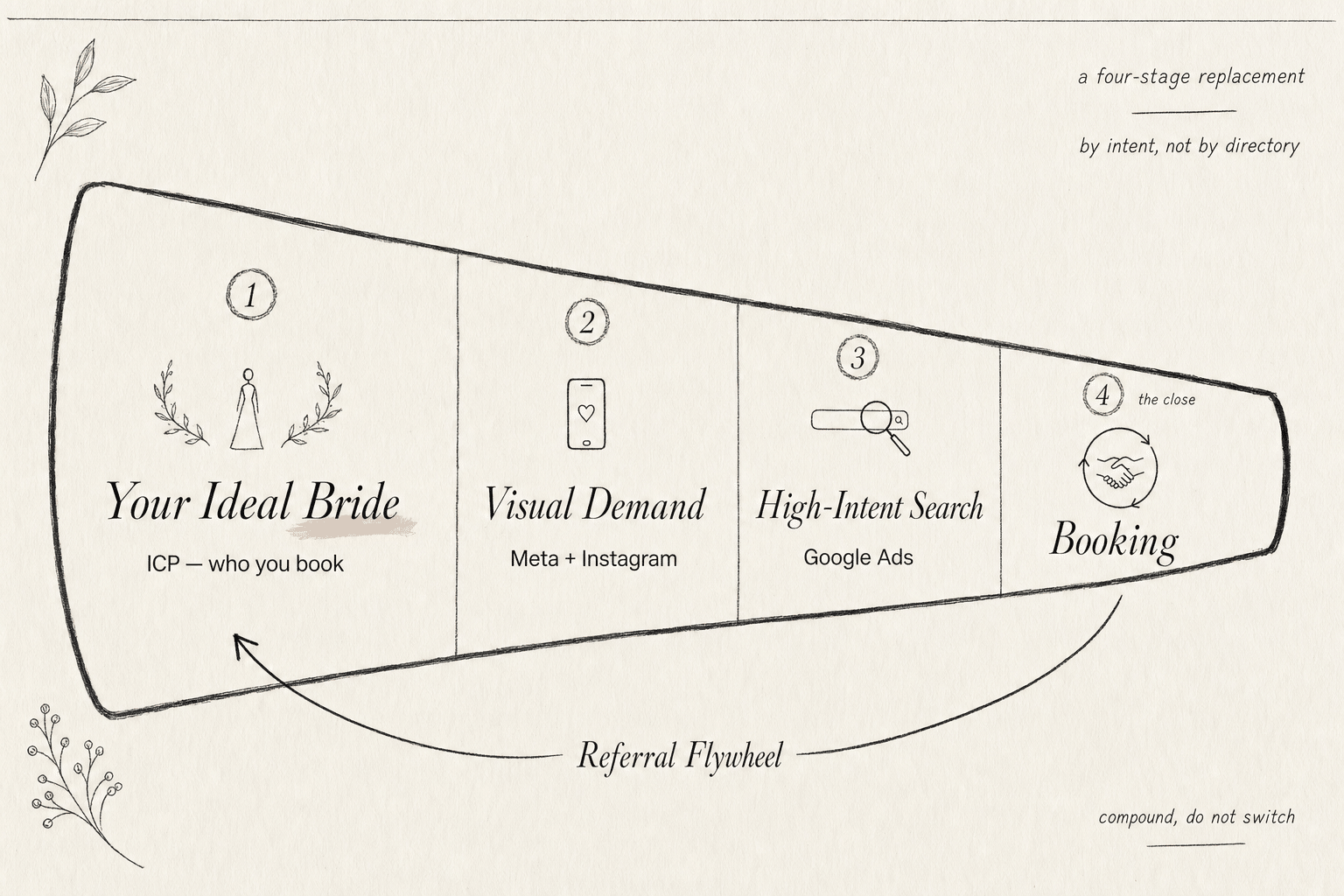
- Your Ideal Customer Profile, sharply defined — knowing exactly which kind of bride you are built to host
- Visual demand on Meta and Instagram — the discovery moment, weeks before the search query
- High-intent paid search on Google — the active-shopping moment
- The referral and repeat-couple flywheel — the channel directories cannot compete with at all
Step 1: Your Ideal Customer Profile (your “ideal bride”)
Before any channel runs, name the bride you are built to host.
Your Ideal Customer Profile — ICP, the same term every paid marketer uses — is the answer to: which bride walks the venue and books on the spot, which bride is a steady “yes” through a 90-day decision cycle, and which bride is a “no” that costs you ten hours of tours and emails before she ghosts? The venues that book at high rates know the answer in one sentence. The venues that lose tours pretend every bride is the right bride.
The pieces of an ICP that change which channel mix works for your venue:
- Aesthetic — modern, rustic, garden, historic, vineyard, ranch
- Budget tier — what your average wedding actually bills at, not what you wish it billed at
- Guest count — the band that fits your space without compromise
- Geography — the metro and the drive radius your venue actually pulls from
- Decision style — couple-led, mother-of-the-bride-led, planner-led, multi-stakeholder
Why this is the foundation of the mix: every channel below filters on these. The venue-marketing playbook goes deeper on ICP-mapping; here the point is narrower — the directory model fails because it doesn’t filter on any of this, and an ICP-defined mix succeeds because every step does.
Step 2: Visual demand on Meta and Instagram (discovery)
Meta owns the discovery moment that precedes the active search. A couple scrolls Instagram for inspiration weeks before they are technically shopping, validates options on Google when they are ready, and inquires through your website. Meta puts your venue inside the inspiration phase. The Knot does not.
| At the discovery moment, The Knot offers… | At the discovery moment, Meta + Instagram offer… |
|---|---|
| Couples browse a list of venues; you compete against the listing above and the one below | Couples scroll their feed; your venue appears inside the visual story they are already consuming |
| Targeting = couples on the Knot platform searching your category and city | Targeting = engaged couples, radius around your venue, household-income proxy, ICP behaviors |
| No couple-side filter for budget before they reach you | Budget proxies (income bracket, browsing behavior) filter audiences before they ever see your ad |
| No UTM-attributable path from impression to inquiry | UTM tagging on every link makes the path from creative → click → inquiry visible by audience cut |
The pre-filtering is what quietly fixes the “low-quality inquiries” complaint. The inquiries are not low quality because the channel is broken; they are low quality because the channel did not filter. Meta filters on your ICP. The Knot does not.
The common failure mode is treating Meta like a billboard. A couple will not book a tour off a single pretty Instagram image. The mechanism that actually converts is a structured campaign (not boosted posts) running long enough for the same couple to see your venue several times across the engagement-season window, paired with creative pulled from real weddings at your venue rather than stock imagery.
Step 3: High-intent paid search on Google
By the time a couple is typing your city, your style, and your category into Google, they are shopping. The directory shows them a list of venues. Google Ads, run well, shows them your specific venue at the moment they are scrolling result one.
The same venues we have watched run both channels in parallel see Google’s tour-book rate run several multiples higher than The Knot’s. The cause is straightforward: a paid-search couple is shopping, a directory couple is grazing, and the platform that meets the shopping couple wins the inquiry.
What makes the channel actually work, when most venue operators get it wrong: keyword bids stay tight to the queries couples actually type (“wedding venues [city]”, “all-inclusive wedding venue [region]”, “barn wedding venues near me”), the paid traffic lands on an offer-specific page on your venue’s own URL rather than the homepage, and the inquiry capture form lives on your domain so every couple is yours from the click forward. The homepage answers is this venue beautiful? The offer-specific page answers is this venue right for me, can I afford it, when can I tour? Different question, different conversion rate.
The cost is comparable to a Knot featured listing in mid-size metros. In top metros, Knot pricing scales faster than cost-per-click does, so the math tilts further in paid search’s favor. The point is not always cheaper. The point is that Google Ads spend reports line-by-line in your account, inquiries route to a CRM you control, and the landing page itself accumulates page authority over months that compounds into your venue’s organic ranking for the same queries.
Step 4: The referral and repeat-couple flywheel
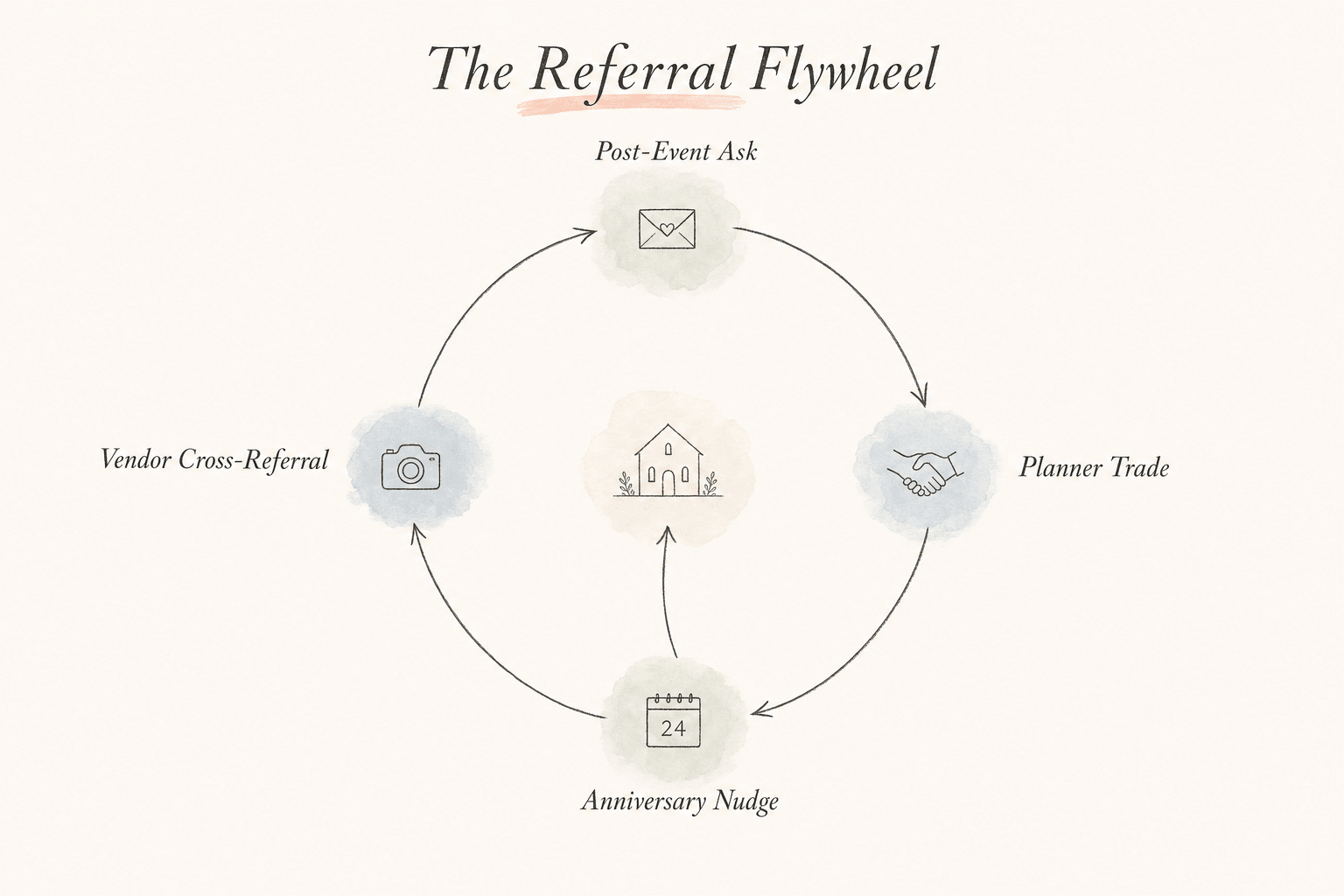
A referred couple already trusts your venue before they walk in. A directory couple has trusted nothing yet. The booking-rate gap is not subtle. Most venues we work with leave this channel underbuilt because the asks are vague. Four mechanisms, with the specific ask that actually triggers each:
1. The post-event ask, sent one week after the wedding. Subject line: One favor before the photos hit Instagram. Body: thank-you, two sentences, and one specific request — a Google review, an Instagram tag with your venue’s handle, or a 90-second video walkthrough at sunset on a weekday when the venue is empty. Specificity beats please refer your friends.
2. The planner-partner trade list. Three to four planners whose aesthetic matches your venue, who you actively refer to and who actively refer back. Reciprocal, not commissioned. The relationship works because both sides earn fit-based referrals.
3. The two-year-out anniversary nudge. A note to past brides at the 24-month mark catches the friend-of-the-bride who has just gotten engaged and is asking where did you get married? One personal message every other year per former couple. The reply rate runs multiple times higher than any cold-outreach metric.
4. The vendor cross-referral. Photographers, florists, caterers, and DJs work venues weekly. They are the highest-leverage referral source most venues never explicitly cultivate. The mechanism: a quarterly venue tour for your top five preferred vendors, plus a printable one-pager they can hand to their next inquiring couple.
What this channel replaces is not The Knot directly. It replaces the “I need more inquiries, I’d better sign The Knot contract” pressure that drives venues into the directory model in the first place. When the referral flywheel is generating a steady fraction of bookings, the directory becomes a backup, not a foundation.
Once the four-channel mix is delivering inquiries, the second half of the equation is conversion. The playbook for turning those new inquiries into signed contracts lives in our 8-strategy guide to booking more weddings at your venue — response-time discipline, package architecture, and the lead-nurture sequence that closes the loop on the channels above.
The 30-day Knot replacement plan
The reason most venues stay on The Knot longer than they should is fear of a gap during the switch. The fix is a controlled overlap, not a hard cut.
Week 1. Define the ICP sentence above. Build the offer-specific page on your venue’s site. Configure the Google Ads account around the top two query buckets for your metro. Launch at a small daily cap. Do not cancel The Knot. You are running the new channel underneath the old one so you have side-by-side inquiry data when the renewal call comes.
Week 2. Launch a Meta campaign with an audience filter matching your ICP (engaged couples, radius, budget proxy). Use creative pulled from real couples married at your venue, not stock or generic interior shots. UTM-tag every URL. Track Google-channel and Meta-channel inquiries against The Knot’s by tour-book rate, not just inquiry count.
Week 3. The Knot rep calls about renewal. By now there are two weeks of side-by-side data. Make the renewal decision from that data, not from the rep’s pitch. The usual move: downgrade to a basic free listing (keep the brand back-link, drop the featured spend), and reallocate the difference into the channels that proved out. (For the full cost picture, see what The Knot actually charges venues and the verdict on whether it’s worth it.)
Week 4. Send the first round of post-event asks to brides married in the last 90 days. Reach out to two or three planner partners whose work overlaps yours. None of this is high-velocity in week 4; these channels compound over months. Week 4 is the start of compounding.
What the mix costs vs. what The Knot costs
The total cost of the channel mix lands in roughly the same monthly territory as a top-tier Knot featured listing. Inside that envelope, the spend behaves differently in four ways that matter at the renewal moment:
- Ad spend is daily-adjustable; The Knot’s featured spend is locked for 12 months.
- Each channel reports separately, so the inquiries you stop getting tell you which channel to tune.
- Inquiries are exclusive: they come only to you, not to the three venues bidding above and below.
- The landing page accumulates organic ranking authority that survives the spend.
Directory dollars rent placement. Channel-mix dollars buy a customer asset that survives the contract.
When The Knot IS still the right call (honest take)
The directory is the right call when:
If the free Knot listing is part of your baseline, layer it with a handful of other free directories rather than relying on it alone. We maintain a current roundup of 12+ free wedding vendor listings worth claiming — including the high-authority directories that quietly out-perform the big three for indie venues.
- Your venue is pre-launch with zero web presence. A Knot listing puts your venue in front of couples faster than the channel mix can ramp from a cold start. The right move there is The Knot as the bridge channel, the four-channel build running underneath, planned exit at month 9 to 12.
- Your metro has so little Google search volume for venues that paid search cannot carry the mix. Rare but real in very small markets. The channel mix still applies; the Google Ads share shrinks and Meta plus the flywheel pick up the slack.
- You are running the free basic listing as a brand back-link, not as your acquisition channel. A free listing for the link and the brand mention is fine. Paying for the featured tier without a clear exit plan is the failure mode this page is about. (See how WeddingWire stacks up against The Knot if you are evaluating both sides of the parent platform.)
Frequently asked questions
Do you save money replacing The Knot?
The total monthly spend on the channel mix is roughly comparable to a featured Knot listing in most metros. The shift is not the line-item cost; it is that every dollar is attributable to a specific inquiry, and the commitment is daily, not annual.
Will I lose inquiries in the first 30 days of switching?
Not if the 30-day plan runs the new channels under the old contract instead of replacing it. The downgrade to the free Knot listing happens in week 3, after the new channels have produced two weeks of comparable data.
Can I run Google Ads myself?
Yes. The two parts that take the most operator learning curve are keeping Google’s default settings from spending your budget on the wrong query types, and building a landing page that converts paid traffic. Both are learnable; both take a few months to do well.
Is The Knot’s free basic listing worth keeping?
Yes in most cases. The free listing is a brand-presence back-link and a discovery surface for couples already on the Knot platform. The failure mode is paying for the featured tier without a clear exit plan, not the free listing itself.
How does this work in a small metro?
Google Ads spend shrinks because there is less search volume to capture. Meta picks up a larger share, and the referral channel matters more, not less. Small-market referral networks are dense and high-trust.
DIY vs. working with a growth partner
Two paths exist for taking the playbook off this page and into a calendar full of tours.
The DIY path: about ten hours of operator time per week for the first 60 to 90 days, most of it in Google Ads. Inquiry parity around month three is realistic; the lag is the Google Ads quality score building, not the operator’s learning curve.
The growth-partner path: the channel mix, run for the venue. If you want to talk through which mix shape fits your specific metro and venue archetype, the sidebar opens that conversation.
The venues that quietly left The Knot eighteen months ago did not replace it with another directory. They built the system that made the directory unnecessary.
Sources
- SBA market research guidance — U.S. Small Business Administration
- how Google Search campaigns work — Google Ads Help (Google)
- Harvard Business Review on customer retention value — Harvard Business Review