

If your contract with The Knot is coming up for renewal, you are probably looking at the leads you received and trying to answer a fairly basic question: was the advertising worth what you paid for it?
That gets complicated when the inquiry count in your dashboard does not match what you remember happening throughout the year. Some leads may have booked tours. Others may have stopped responding after the first message. A few couples may have told you they had already been following your venue on Instagram or had found you on Google.
That is where the question “Are The Knot leads fake or real?” usually comes from.
There is a useful distinction to make before you decide what those leads were worth.
Real is not the same as new.
A legitimate couple can submit an inquiry through The Knot after they already know your venue by name. They might have first seen the property on Instagram, heard about it from a friend, found it through a Google search, or visited your website. If they eventually use the contact form on your Knot listing, that inquiry appears in your Knot account.
For a venue owner deciding whether to renew, the question becomes: How many couples did The Knot introduce to your venue, and how many already knew you existed?
You can start answering that with data you probably already have.
Are The Knot Leads Fake or Real?
There has been enough public discussion around The Knot’s leads that venue owners have reason to ask.
In 2025 and 2026, Sen. Chuck Grassley sent multiple letters to the Federal Trade Commission concerning allegations made by wedding vendors about The Knot. Among those allegations were claims that some vendors received leads they considered fake or lacking legitimacy. Grassley’s April 2026 letter said his office had received hundreds of messages from small-business owners alleging misconduct. These remain allegations rather than a determination by the FTC.
The Knot Worldwide has denied creating fake leads or deploying fake couples. In an April 2025 statement to wedding professionals, the company said repetitive messages can come from its prewritten inquiry templates, while some apparently poor-quality leads may reflect ghosting or spam. The company reported that less than 1% of its leads had been marked as spam by vendors during the prior year.
Those two positions have driven much of the conversation around The Knot vendor complaints, although they do not answer the attribution question facing an individual venue.
You may have completely legitimate couples sitting in your Knot inbox.
You still need to know how they got there.
The source attached to an inquiry generally tells you where that inquiry was submitted. It does not necessarily document the first place the couple encountered your venue.
That matters when you are evaluating the return from a paid listing.
Why Couples Who Already Know Your Venue Can Still Show Up as Knot Leads
Think about how someone researches a wedding venue.
A couple sees one of your weddings on Instagram and remembers the venue name. A few weeks later, they search that name on Google. They visit your website and read your reviews. During another round of research, they reach your listing on The Knot and send an inquiry from there.
Your Knot dashboard now contains a Knot inquiry.
A couple can already know your venue, search for you by name, land on your Knot listing, and submit the inquiry there. When that happens, The Knot records the contact as a Knot lead even though the couple may have found your venue somewhere else first.
That can happen in a few ways.
A couple may first see your venue on Instagram, hear about it from a friend, or come across it in a Google search. Later, they search your venue name directly because they want pricing, reviews, photos, or more information.
Search your venue name on Google and look at what appears above and around your own website. In some markets, directory listings or sponsored results can appear during a branded search. A couple who is specifically looking for your venue may click one of those results and end up on The Knot.
Once they are there, the inquiry form gives them an easy place to contact you. The lead then appears in your WeddingPro account under The Knot because that is where the form was submitted.
This is why lead source and discovery source can be different.
The Knot may have captured the inquiry. Google, Instagram, a referral, or another source may have created the original interest.
That distinction matters at renewal time because you want to know how many couples The Knot introduced to your venue and how many were already looking for you when they reached the platform.
Run the Branded-Search Test Before You Renew
The Branded-Search Test looks at your recent Knot inquiries alongside evidence that couples are already searching for your venue by name.
It will not give you perfect person-by-person attribution for old leads. Google does not provide that level of information. It can give you a much clearer picture of what is happening, especially once you start asking couples one additional question.
Use the same 90-day period across each step.
1. Pull Your Last 90 Days of Knot Inquiries
Start inside your WeddingPro account and pull the inquiries attributed to The Knot from the previous 90 days.
For each inquiry, record a few basic details:
- Couple’s name
- Inquiry date
- Whether they responded
- Whether they booked a tour
- Whether they booked a wedding
- How they first heard about the venue, if you already know
You are creating a list you can compare against what was happening elsewhere during the same period.
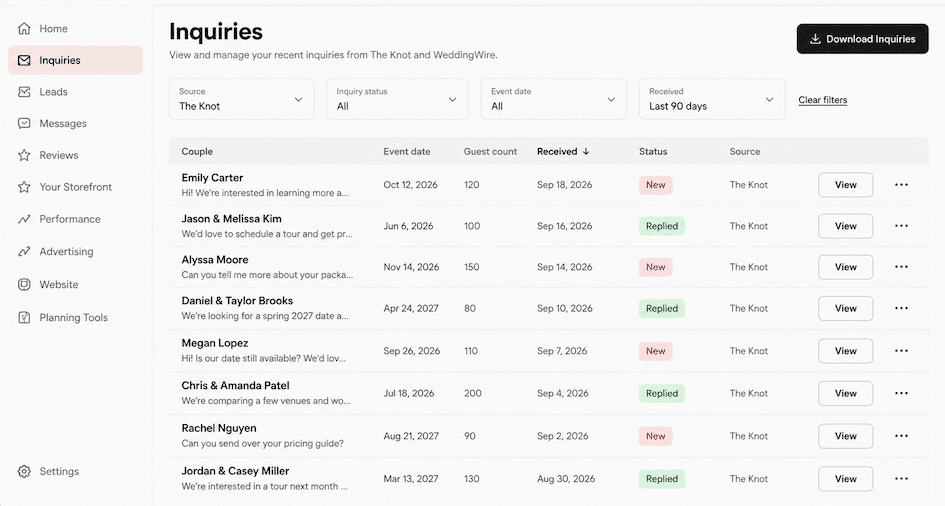
Illustrative example only. This graphic is a recreated interface using sample data and does not show an actual venue account.
Do not remove ghosted leads or poor-fit leads yet. At this stage, you want the full picture of what The Knot reported.
2. Look at Searches in Your Google Business Profile
Next, open the Google account connected to your Business Profile and view its performance information for the same period.
Google’s Business Profile performance report includes the search terms people used when the profile appeared on Google Search or Maps. You can also change the date range so you are comparing the same window you used for your Knot leads.
Look for searches such as:
- Your exact venue name
- Your venue name + wedding
- Your venue name + pricing
- Your venue name + reviews
- Common misspellings or variations of your venue name
You are looking for evidence that people are actively searching for the property specifically.
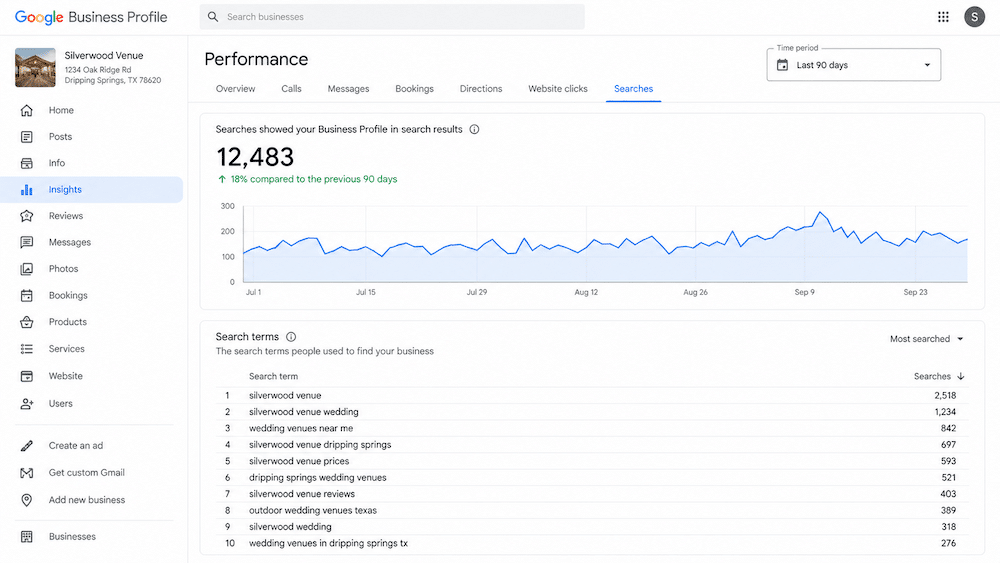
Illustrative example only. This graphic is a recreated interface using sample data and does not show an actual venue account.
A branded search does not prove that a particular person later submitted a Knot inquiry. Google Business Profile data is aggregated, so resist trying to match one search to one couple.
The value is in seeing the amount of existing interest around your name.
3. Check Branded Searches in Google Search Console
Google Search Console shows the search queries people used before landing on your website.
Open:
Search Console → Performance → Search results → + Add filter → Query → Queries containing
Enter your venue name, then click Apply.
That will show searches containing your venue name during the selected date range. Run the same search again using a shortened version of your venue name if couples commonly use one.
Look at both clicks and impressions. Those numbers can show how often people are actively searching for your venue by name and seeing your website in Google.
Use the same 90-day window you used for your Knot inquiries so the periods line up.
This still will not tell you that a specific Google search became a specific Knot inquiry. It gives you another piece of evidence that branded demand already existed during the same period.
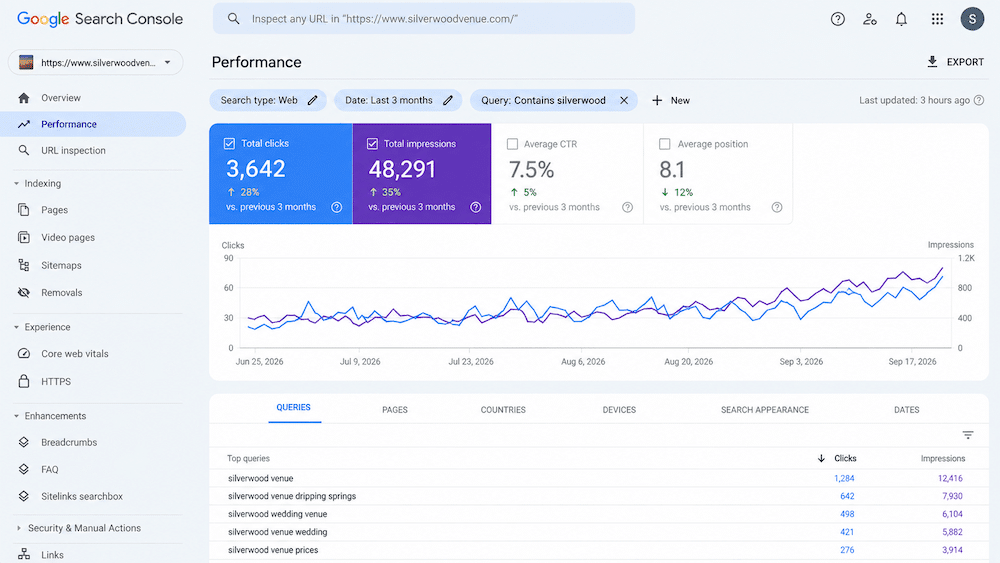
Illustrative example only. This graphic is a recreated interface using sample data and does not show an actual venue account.
If your venue generates substantial branded search activity during the same months that you are receiving Knot inquiries, you know couples are already looking for the property directly on Google.
Again, this is evidence of existing demand rather than proof about one specific inquiry.
The next step gets you closer to that answer.
4. Ask Couples How They First Heard About You
Add one question to your inquiry process:
“How did you first hear about us?”
The word first matters.
If you ask, “How did you hear about us?” a couple who just completed your Knot form may reasonably answer “The Knot.” That tells you where they recently interacted with you.
Asking where they first heard about the venue gives you a better chance of identifying discovery.
Give couples simple options if you use a dropdown:
- Instagram or Facebook
- The Knot
- WeddingWire
- Friend or family referral
- Wedding planner or vendor
- Local knowledge or drove by
- Other
Record their answer alongside whatever source your CRM or inquiry platform assigned to the lead.
Interestingly, WeddingPro has given similar advice in its own educational material. It recommends asking prospective couples where they first found or heard about a business to develop a clearer picture of advertising ROI.
Keep collecting this information after your initial 90-day review. Within a few months, you will have much stronger first-party attribution data for the next marketing decision.
What Kind of Knot Leads Are You Actually Getting?
Once you have gone through the test, place your Knot inquiries into a few basic categories.
| Knot Lead Type | What It Means |
|---|---|
| New discovery | The couple says they first learned about your venue through The Knot. |
| Found you first | The couple already knew about your venue through Google, social media, a referral, or another source and later used The Knot to inquire. |
| Comparison shopper | The couple was actively researching several venues and contacted yours as part of that process. |
| Not a fit | The inquiry came from a real couple, but their date, budget, guest count, location, or another requirement did not match your venue. |
These categories give you considerably more information than one number labeled “leads.”
Consider an illustrative example.
The following numbers are made up for demonstration and are not Fully Booked Venue client data:
Say a venue received 20 Knot inquiries last quarter.
After reviewing those inquiries and asking couples how they first heard about the property, the owner finds:
- 6 first found the venue through The Knot
- 8 first found it through Google, social media, referrals, or another source
- 4 were researching a large group of venues
- 2 were outside the venue’s basic requirements
The dashboard still accurately shows 20 Knot inquiries because all 20 used the platform to make contact.
For the renewal analysis, the owner now knows that six couples identified The Knot as their original point of discovery.
The owner can look at what those six couples did next. How many scheduled a tour? How many showed up? How many booked? What revenue did those weddings create?
You can run the same analysis for couples who already knew the venue and see which channels appear to be generating that initial interest.
Should You Renew The Knot?
Once you know what types of inquiries you are receiving, the renewal decision becomes easier to evaluate using your actual numbers.
Start with the amount you spent during the period you are reviewing.
Then look at:
- Total Knot inquiries
- Couples who say they first found you through The Knot
- Tours booked from those inquiries
- Weddings booked
- Revenue from those weddings
A venue receiving meaningful new discovery and profitable bookings through The Knot may decide the current investment still deserves a place in its marketing budget.
Another venue may find that The Knot contributes to discovery, while the current tier costs more than the owner wants to spend for the resulting bookings. That owner may want to compare a lower tier with the current contract.
A third venue might learn that a large share of its Knot inquiries already knew the property. The owner can compare the renewal cost with what the same budget could fund in Google, SEO, Meta advertising, or another channel responsible for generating awareness in the first place.
At that point, the decision comes down to what the channel is actually contributing. Look at how many couples first found you there, how many of those couples toured, how many booked, and what those bookings were worth.
That gives you a much better basis for evaluating the renewal than the lead count in your dashboard alone.
You can run those numbers through the Fully Booked Venue ROI calculator before you make the call. This tool helps you compare your marketing spend against leads, tours, bookings, and revenue so you can see what a channel is actually returning.
Are The Knot Leads Fake or Real? Know What You Are Paying For

The debate over whether The Knot leads are fake or real gets attention because it speaks to a frustration many wedding professionals have experienced.
For your venue, the more useful analysis happens inside your own lead data.
Find out how many couples first encountered you through The Knot. Check how much branded demand already exists around your venue on Google. Start asking every new inquiry where they first heard about you, and track what happens to those leads after they arrive.
You will have a much clearer picture of what your Knot investment is producing when renewal time comes around.
If you decide The Knot is not where you want to put your next marketing dollar, you can also book a Fully Booked Venue Competitive Review. We’ll look at where your leads are coming from, what those channels are costing you, and where you may have better opportunities to generate inquiries and tours.
Key Takeaways
- A Knot inquiry tells you that a couple contacted you through the platform. It may not identify where that couple first learned about your venue.
- Branded searches in Google Business Profile and Search Console can show how often people are already looking for your venue by name.
- Asking “How did you first hear about us?” gives you useful first-party attribution for future leads.
- Separate new discovery, found-you-first leads, comparison shoppers, and poor-fit inquiries when reviewing Knot performance.
- Compare renewal cost with tours, booked weddings, revenue, and first-touch discovery rather than relying on total inquiry volume alone.
Are The Knot leads fake?
There have been public allegations from some wedding vendors that they received fake or low-quality leads through The Knot, and The Knot has denied sending fake leads. For an individual venue, the more useful question is how many inquiries came from couples The Knot introduced to the venue and how many came from couples who already knew the venue and used The Knot to make contact.
How do I know if a Knot lead found me on Google first?
Check branded search activity in Google Business Profile and Google Search Console, then compare it with your Knot inquiries from the same period. The strongest attribution signal comes from asking every couple, “How did you first hear about us?” and recording that answer alongside the lead source.
Why do couples inquire through The Knot if they already know my venue?
A couple may search your venue by name, click a Knot listing or sponsored result, and use the inquiry form there because it is convenient. In that case, The Knot captures the inquiry even though the couple may have first found your venue through Google, Instagram, a referral, or another source.
What should I track to know where my bookings come from?
Track the couple’s first discovery source, the platform where they submitted the inquiry, whether they booked a tour, whether they booked the venue, and the revenue tied to that booking. Keeping those fields separate gives you a clearer picture of which channels are creating demand and which ones are capturing it.