You have seen the lists. “Post on Instagram. Run Facebook ads. Optimize your website.” Every venue marketing article says some version of the same thing. None of them show you what that actually looks like when it works.
This page is different. What follows are real marketing examples from wedding venues. Each entry covers specific tactics, the mechanism behind why each one works, and what to watch for when you apply them to your own property. Some come from venues we work with directly. Others are observable from public sources like the Meta Ad Library or Google Search results. All of them are actionable in a way that “run social media” is not.
What separates a real venue marketing example from a listicle
A real example answers four questions: What did the venue do specifically? Why did it work mechanically? What did they measure? And what would a different venue need to adapt to make it work in their market?
Most venue marketing content fails on the second question. “Post more consistently” isn’t an example. It’s an instruction. “Post real wedding photos every Tuesday and Sunday at 9am, never staged editorial, and respond to every comment within two hours” is an example. The difference is specificity you can actually model.
The examples below are organized by the challenge they solve, not by marketing channel. Most venues have multiple channels active and need to understand how the pieces connect to the inquiry pipeline, not just what buttons to press.
Inquiry response time: the fastest marketing fix most venues ignore
Every venue marketing example worth reading eventually connects to inquiry conversion. You can have a perfect Instagram grid, a high-ranking Google listing, and a beautiful website, and still lose bookings to a competitor who responds within ten minutes while you respond the next morning.
Inquiry response time is the single most impactful variable in booking conversion for venues doing any volume of inbound. In our experience working with venues across different market sizes, the venues converting 35 to 45 percent of inquiries into tours typically respond within 15 minutes during business hours. Venues responding within the same day convert at roughly half that rate. Venues with next-day response rates struggle to break 10 to 15 percent tour conversion from cold inquiries.
This isn’t because couples are impatient. It’s because they submit the same inquiry form to three to five venues at once. The venue that responds first with a warm, specific message usually gets the tour booking before the others even pick up the thread.
What a fast-response system actually looks like
One venue we work with built a response sequence around three messages: an immediate auto-reply that sets a human expectation (“You will hear from someone on our team within 15 minutes”), a personal reply from a coordinator that references something specific from the couple’s inquiry form (guest count, date preference, style they mentioned), and a second-day follow-up that sends the pricing guide and a direct link to schedule a tour.
The auto-reply isn’t the closer. It’s a holding message that prevents the couple from moving to the next tab. The personal reply within 15 minutes is what earns the conversation. The second-day follow-up with the pricing guide answers the question couples always have but don’t always ask: can we afford this place?
If your team can’t realistically respond within 15 minutes during business hours, the more achievable version is setting a clear expectation: “We reply same-day Monday through Friday, and within 4 hours on weekends during peak season.” Then actually meet it. Couples accept slower response windows when the expectation is set upfront. What they don’t forgive is a promise of “we’ll be in touch soon” followed by a 22-hour silence.
Google Business Profile: the venue marketing lever with the highest free ROI
The wedding venues that reliably appear in the Google Maps local pack for their market (those three listings with star ratings and photo thumbnails at the top of search results) are doing something systematically that most venues treat as optional maintenance.
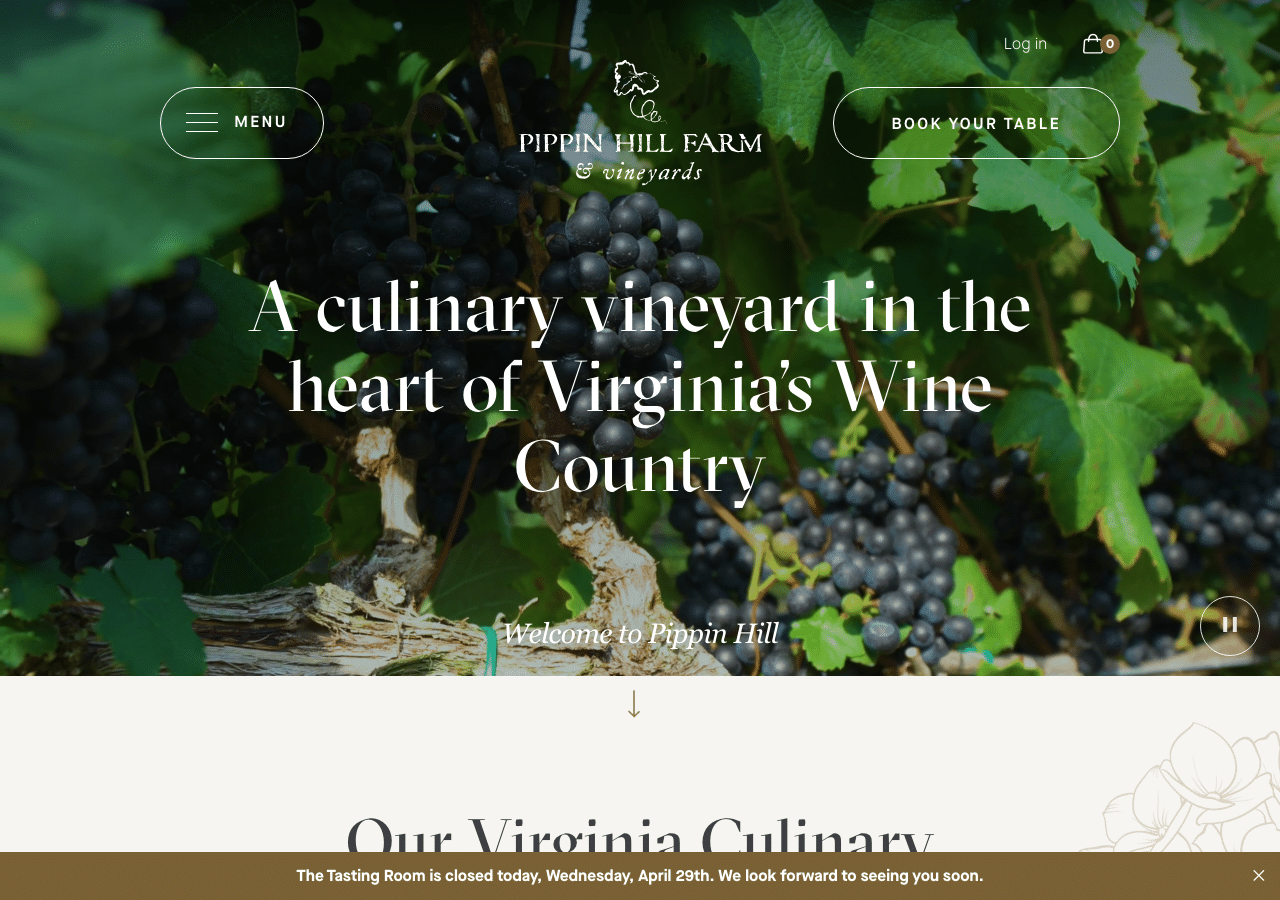
Pippin Hill Farm and Vineyards in Virginia is a useful reference point because their GBP profile shows what consistent photo management looks like at scale. At any given time, their profile has a mix of ceremony setup photos, reception detail shots, and vineyard landscape images. The most recent uploads are never older than 60 to 90 days. This isn’t an accident. It’s a deliberate policy: every event generates three to five GBP uploads before the couple posts their own reviews.
The mechanism: Google’s local ranking algorithm treats photo recency as an activity signal. A venue with 300 photos all uploaded in 2022 will typically rank below a venue with 80 photos, 20 of which were added in the last six months. The photos signal that the business is active and engaged, which Google values in the same way it values fresh review dates.
The specific photos that drive the most inquiries
Not all GBP photos perform equally. From the venues we track, three photo types generate the most profile visits and direction requests:
- Full ceremony or reception setup shots: the room or outdoor space at capacity with an actual couple’s color scheme and decor. Empty room photos show the space; set-up photos show what it looks like on a real wedding day.
- Outdoor ceremony spaces in natural light: couples searching for “outdoor wedding venues” are picturing a ceremony under open sky. A photo that matches that image is what stops the scroll.
- Floor plan or layout shots from above: the question “will this space fit my guest list” is asked in the first 30 seconds of every venue visit. A layout photo answers it visually without requiring the couple to read a PDF.
One practical addition that most venues skip: seeding the GBP Question and Answer section yourself. The Q&A section appears in search results and allows anyone to ask questions publicly. Log in and add the questions you hear on every tour: “Do you allow outside catering?” “Is the venue available for Friday weddings?” “What is included in the rental fee?” Answering these yourself gives Google keyword-rich content and gives couples an immediate answer before they even click through to your website.
Facebook and Instagram ads for wedding venues: what actually runs
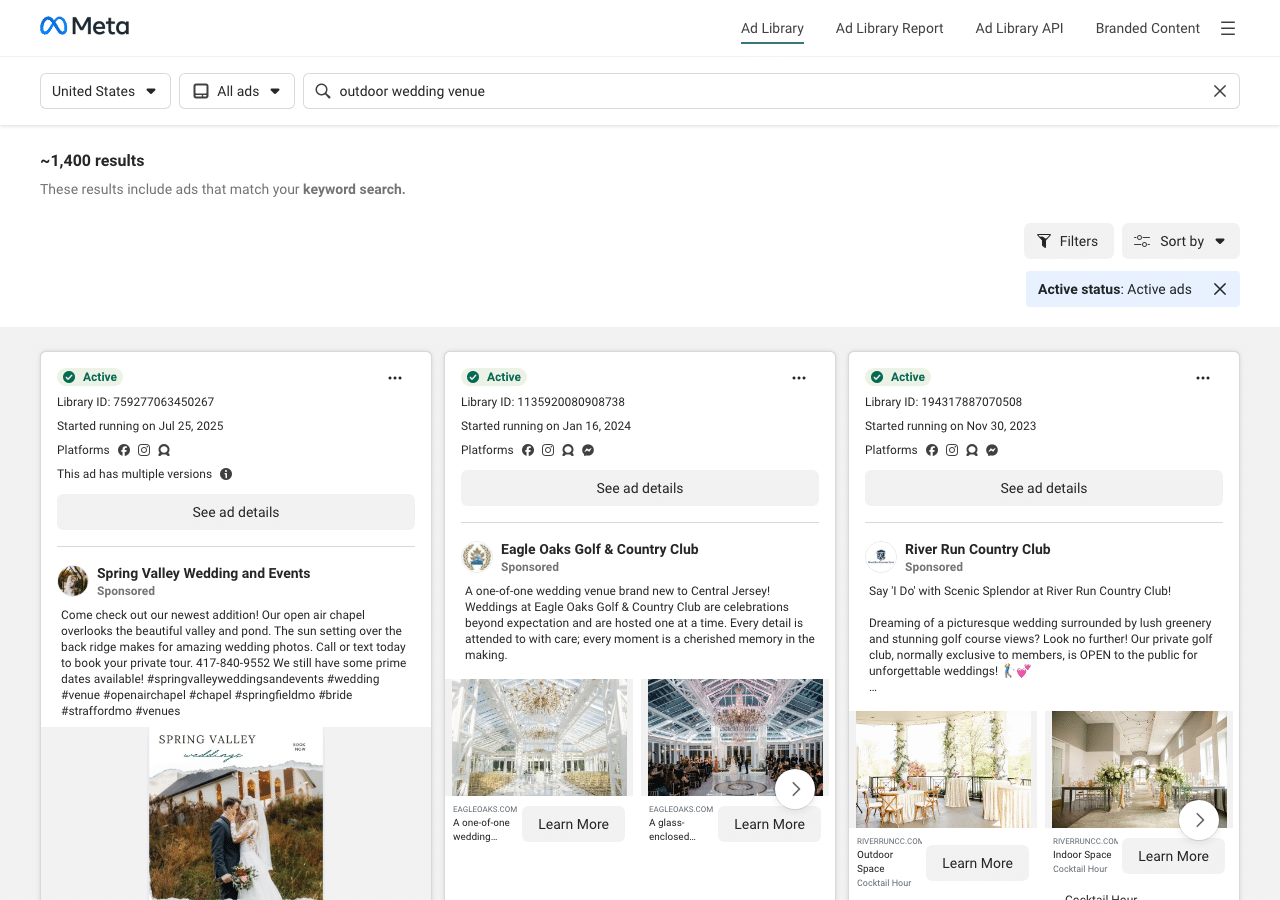
The Meta Ad Library is publicly searchable and shows every active ad running on Facebook and Instagram. Searching “wedding venue” or “outdoor wedding venue” in the Ad Library reveals what real venues are spending money on right now, which is useful because it shows the formats and hooks that venues believe are working, based on how long they keep running the same creative.
A few patterns are visible across the venues actively running ads:
The tour invitation ad
The most common format running for venues is a direct event or tour invitation: “Join us for a private tour and tasting Saturday, [date]. See the ceremony space, meet our coordinator, and fall in love with your venue.” The photo is always the ceremony space or outdoor grounds. Never a headshot of staff, never a logo card.
This format works because it creates a specific action (attend a tour event) with a deadline (specific date), which converts better than a generic “book a tour anytime” message. River Run Country Club’s active ads use this format: a specific date, a specific action, a photo of the reception space, and a “Learn More” button that goes directly to a tour booking page, not the homepage.
The common mistake in this format is sending the click to the homepage. Couples who click a tour invitation ad and land on a general homepage have to find their own way to the tour booking form. The conversion rate on that path is significantly lower than sending the click directly to the tour inquiry form, pre-filled with the date from the ad.
The aspirational imagery ad
The second format that appears consistently is a high-quality single image of the venue in ideal conditions: outdoor ceremony at golden hour, reception hall fully decorated, with copy that leads with a sensory description. “Imagine exchanging vows surrounded by [location-specific detail]. Our [venue name] is booking [season] dates now.” Then a link to view availability.
This format doesn’t close a booking. It generates an inquiry from a couple who is early in their venue search. The follow-up sequence after that inquiry is what actually closes the booking. That is why venues running aspirational ads without a structured follow-up process usually see disappointing ROI from their ad spend. The ad gets the couple in the door. Your inquiry system has to handle the conversion.
Targeting: who to reach and who to exclude
Venue Facebook and Instagram ads work best with tight geographic targeting: typically 30 to 50 miles from the venue, and audience signals that indicate engagement status. Meta’s “Life Events” targeting includes “Newly Engaged,” which places your ads in front of couples within 6 months of their engagement announcement. Combined with an age range of 24 to 38 and geographic radius, this produces a much higher-quality inquiry pool than broad demographic targeting.
Running a lookalike audience built from your past inquiry list (or better, your past booked couples list) is the other targeting approach that consistently outperforms interest-based targeting for venues. Meta’s algorithm finds the people who look most like the couples who have already inquired with you. In a well-run campaign with a clean past-client list, the cost per inquiry from lookalike audiences is typically lower than from interest-based targeting within 30 to 60 days of running.
Email follow-up sequences: what happens after a couple goes quiet
Ghosting happens at every stage of the venue booking process. A couple submits an inquiry, gets your pricing guide, takes a tour, and then stops responding. This isn’t always a signal that they chose someone else. It’s frequently a signal that they’re overwhelmed, distracted, or waiting for a date to open up with a specific vendor.
The venues that convert more of their toured couples into booked weddings have a structured follow-up sequence that continues contact without being pushy. The sequence that works is built around a single principle: every message gives something rather than asking for something.
A follow-up sequence that reduces ghosting
Here’s what a five-touch follow-up sequence looks like in practice for a venue that has completed a tour but has not received a signed contract:
- Day 1 after tour: A personal note that references something specific from the tour: what the couple responded to, what they asked about. “You mentioned wanting the ceremony under the oak canopy. I pulled the three dates in August that are still available if you wanted to hold one while you decide.”
- Day 4: A piece of useful information with no ask attached. A planning checklist, a post on what couples typically book first, a vendor referral list. Something that helps them even if they don’t choose you.
- Day 10: A date-specific urgency message. “Your date is still available. We had three other inquiries this week for the same Saturday. I can hold it for you through the end of the week if you are still considering.”
- Day 18: A light check-in. “No pressure at all. Just wanted to make sure you had everything you needed to make your decision. If there were any questions from the tour we did not cover, I am happy to answer them.”
- Day 30: A final touch that closes the loop either way. “We are releasing our held date availability this week. If you’re still considering, now is the time to let me know. If you have gone another direction, no worries at all. Wishing you an incredible wedding wherever you land.”
The Day 10 message is the most important. It creates genuine urgency without inventing false scarcity. If the date really does have other interest, this message is honest and timely. If it does not, adapt the message: “Your date is available and I want to make sure you have the time to make the right decision, but prime Saturdays in that season typically hold within four to six weeks of this point in the year.”
Local SEO content that generates direct venue inquiries
Wedding venue advertising via paid channels can generate inquiries immediately. Local SEO content generates inquiries for years on the same initial investment. The trade-off is time: content takes six to twelve months to rank meaningfully and another six to twelve months to build the compounding effect that makes it worth the investment. The venues that benefit most from local SEO content are the ones who started two years ago.
The second-best time to start is now, and the right content to start with is the content closest to booking intent.
The content that ranks and converts in the venue space
Three content types consistently outperform in the venue niche:
Pricing transparency pages. “How much does a wedding venue cost in [your city]” is one of the most searched queries in any active wedding market. Venues that publish honest pricing ranges (even without specific package prices) that rank for this query and attract couples who are ready to have a real conversation. The couples who find this content are already filtering by budget. They are higher intent than couples who find you through an Instagram ad.
A venue in a mid-sized market that published a “What Does a Wedding Venue Cost in [City]?” page , including their own pricing alongside a general market overview. That page become their second-highest source of direct inquiries within 14 months. The page ranked for six related keywords including “[city] wedding venue prices,” “affordable wedding venue [city],” and “wedding venue packages [city].”
Venue-specific local posts. “Outdoor wedding venues in [your county or region]” and “[season] weddings in [area]” are location-specific searches that a local venue can own if it publishes content specific enough to match the search. A post about “Fall Wedding Venues in the Blue Ridge Mountains” that actually describes the foliage timing, the best ceremony lighting in October, and specific setup logistics for cooler weather performs far better than a post that uses “Blue Ridge Mountains” as a geographic keyword without delivering on the search intent.
Questions couples ask before booking a tour. “What to look for when touring a wedding venue” and “Questions to ask your wedding venue before signing” are high-intent searches from couples who are close to making a decision and vetting their options. A venue that publishes a genuinely useful answer to these questions builds authority with the reader and captures a couple who is already deep into the booking process. Eagle Oaks Golf and Country Club, visible in Meta’s Ad Library, also runs organic content that targets this phase of the couple’s research, using their venue’s specific features to answer the questions couples bring to every tour.
What a venue marketing plan looks like in practice
The venues that sustain strong inquiry volume across seasons aren’t doing more marketing than everyone else. They’re doing fewer things more consistently and measuring each one against a clear outcome.
A practical venue marketing plan has three operational layers:
Monthly foundation tasks: Three to five new photos uploaded to Google Business Profile. One or two Google reviews requested from recent events. Any inquiry data reviewed: which source sent the most inquiries last month, what the response time looked like, what the tour conversion rate was.
Quarterly content tasks: One substantial blog post targeting a local search query. A review of the top three GSC queries driving impressions. If any of them has high impressions and low clicks, the title tag or meta description needs to change. A check on the inquiry follow-up sequence: are all five touches going out consistently, or has the sequence broken down somewhere.
Annual decisions: Whether the directory spend (The Knot, WeddingWire, etc.) is worth renewing based on actual booked weddings attributed to each platform. Whether the paid ad channels are generating inquiries at a cost you can justify against your average booking value. Whether the website homepage headline still reflects what couples in your market are actually searching for.
The common failure mode we see in venue marketing plans is that the annual decisions get made in January and then ignored until the next January. The venues that consistently outperform their market review these decisions quarterly, not annually. If paid ads are generating inquiries at twice the expected cost per booking in month three, waiting nine more months to adjust is expensive.
Read next: A connected wedding venue marketing system — 20 ideas in 4 layers →
Venue marketing ideas that are worth your time vs. ones that are not
Not every marketing idea that circulates in the venue industry is worth implementing. A few common examples of where venues overspend time and budget relative to the return:
- Influencer partnerships: A venue that pays or trades with a wedding influencer for an Instagram post typically sees a spike in profile visits and a minimal increase in direct inquiries. Influencer audiences follow people, not venues. The couple who books from an influencer post is the exception, not the rule, and the attribution is nearly impossible to confirm.
- Pinterest management: Pinterest can drive traffic to a venue website, but the conversion path from Pinterest to an inquiry is long and difficult to measure. The time investment required to maintain an active Pinterest presence consistently outperforms what venue teams can sustain alongside their actual operations.
- Directory advertising without a baseline: The Knot and WeddingWire work for some venues in some markets and don’t work for others. The mistake is signing an annual contract without establishing a clear measurement baseline first. What is your current cost per booked wedding from direct inquiries? What cost per booked wedding would the directory need to achieve to be worth the spend? If you can’t answer both questions before signing, you won’t be able to evaluate whether the contract was worth it when renewal comes up.
The marketing that does consistently work for venues regardless of market size: fast inquiry response with a structured follow-up sequence, a well-maintained Google Business Profile with recent photos and answered reviews, and two to three pieces of local search content published each year that answer real questions couples are asking before they book a tour. That combination is less exciting than influencer partnerships and paid social campaigns, and it’s more reliable for filling a venue calendar year over year.
If you want to know exactly where your venue stands across these channels: what your current inquiry conversion rate looks like, where couples are dropping out of your follow-up sequence, and which marketing channels are actually producing booked weddings versus just inquiries. A strategy call is a good starting point. We will look at the numbers together and identify which of these examples applies most directly to your venue’s current situation.