Most lists of wedding venue marketing ideas give you twenty disconnected tactics and call it a system. Pick a few, do them when you can, hope something works. That is not marketing. That is activity.
The venues we have watched fill their calendars consistently do not do twenty things. They run a connected system of four layers, in a deliberate order, and they refuse to skip ahead. The ideas in this post are organized inside that system so you can see which ones are foundation, which create demand, which convert inquiries into booked tours, and which only work once the first three are honest.
Why “Wedding Venue Marketing Ideas” Lists Usually Fail You
The standard advice is a checklist of tactics: post on Instagram, run Meta ads, optimize your Google Business Profile, get on The Knot, send email. Each one is fine in isolation. None of them tells you the order, the dependency, or the math.
What we see at independent wedding venues is that the constraint is almost never “we need more inquiries.” The constraint is one of these three: the website does not answer the questions a couple has before they will book a tour; the response to a new inquiry is slow, generic, or arrives after the couple has already booked a tour elsewhere; or the venue is paying for shared aggregator leads and competing with three other venues for every couple. Adding more “ideas” on top of any of those does not help. It adds cost.
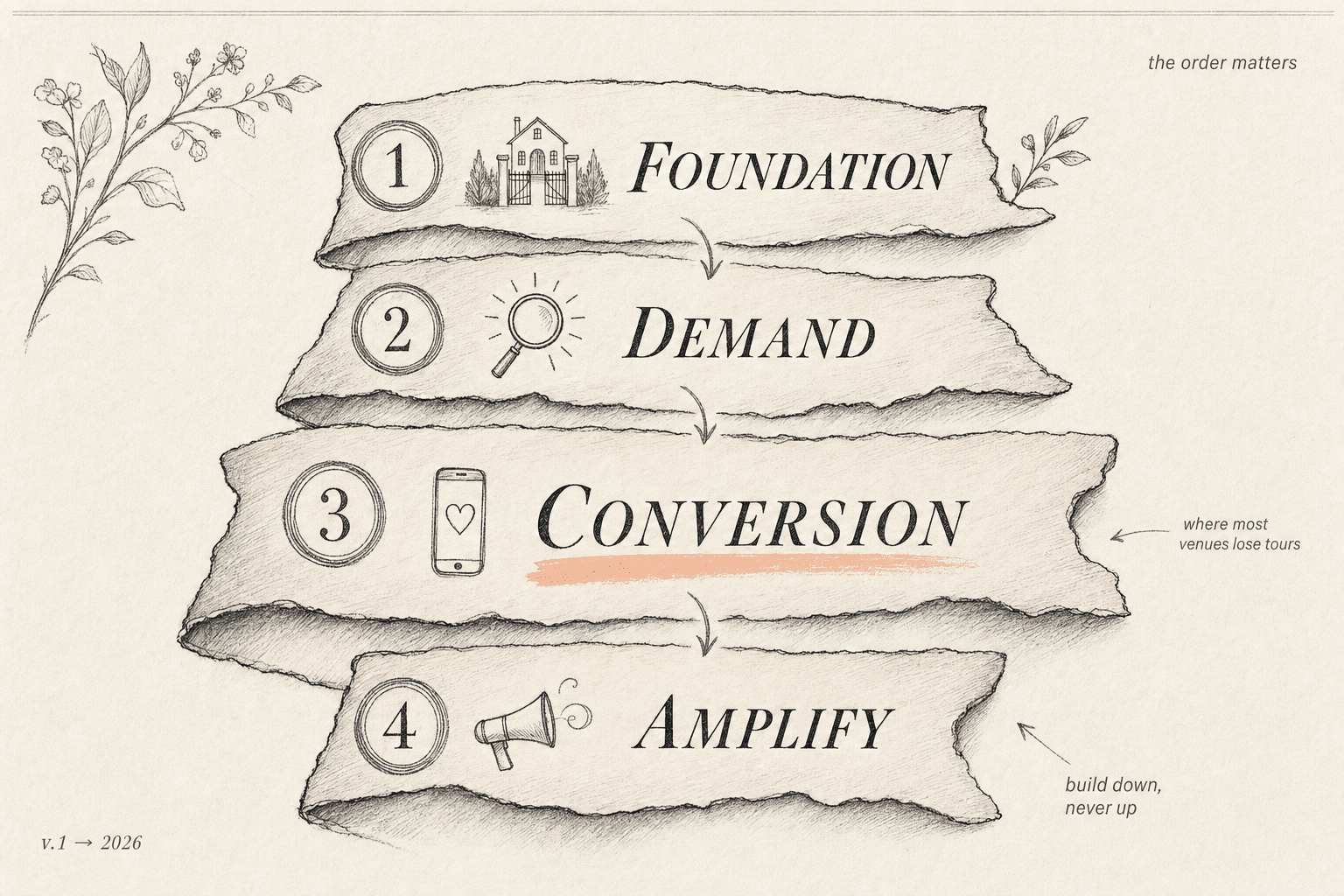
So before the list of twenty, here is the system the list lives inside. We call it The 4-Layer Booking System: Foundation, Demand, Conversion, Amplify. You build them in that order. You do not move down the list until the previous layer holds.
Layer 1: Foundation — What You Own
Foundation is the work that lives on your own property. It does not rent attention from anyone. If you stop paying tomorrow, it keeps working. This is where every venue should start, and it is the layer most often half-built.
1. A website that answers the four questions couples ask before they tour
Couples decide whether to inquire based on four things they want to know before they commit fifteen minutes to a form: roughly what does it cost, does it fit my guest count and date, what is the venue actually like beyond the staged photos, and what is included so I can compare honestly. Your homepage and pricing page should answer all four above the fold. Venues that publish a pricing range publicly receive fewer inquiries on raw volume and meaningfully more tour bookings on percentage, because the inquiries that come through have already self-qualified.
2. A complete Google Business Profile that earns the map pack
The Google map pack is where local search starts and finishes for most engaged couples. Claim your GBP, pick the precise primary category (Wedding Venue, not Event Venue), add every service couples search for as an explicit service item, and post seasonal photos every month. Reviews matter and recency matters more than total count: a venue with thirty reviews from the last twelve months outranks a venue with eighty reviews when the most recent is two years old.
3. A real CRM that holds the inquiry-to-contract lifecycle
Spreadsheets and inboxes are not a CRM. A real CRM holds the inquiry source, the couple’s date and guest count, every touch you have had with them, and a clear stage (inquired, qualified, toured, proposal sent, booked, lost). Without this you cannot tell which marketing dollars produce booked weddings, which means you cannot kill what is wasting money or scale what is working.
4. Editorial photography that shows the venue alive, not staged
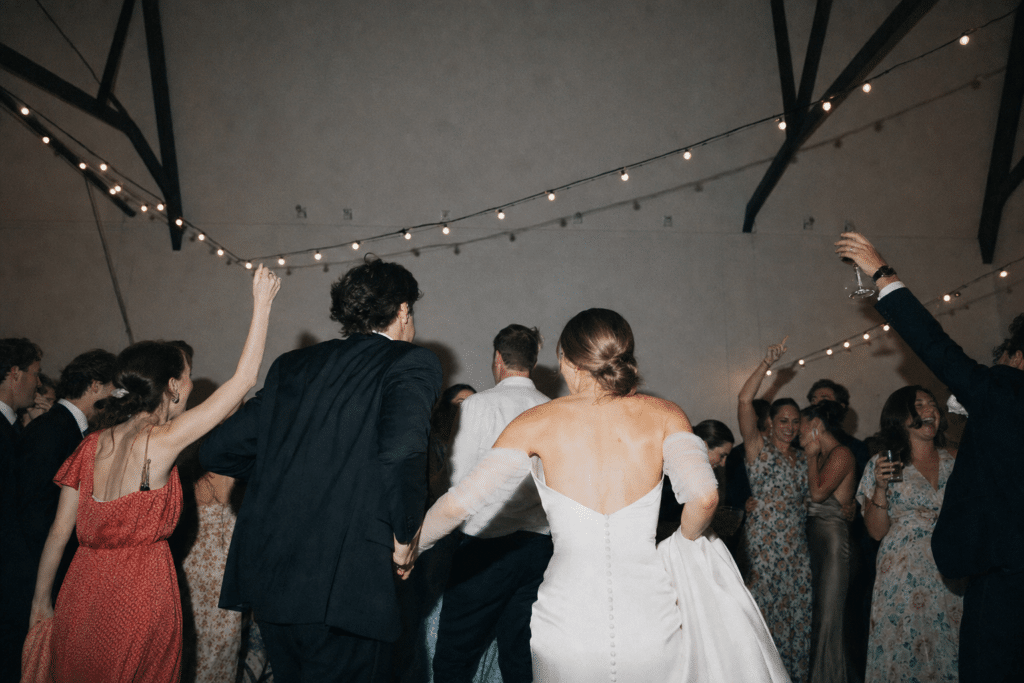
Stock-feeling venue shots with empty chairs and a single florist’s arrangement read as a rental space. What converts is a library of real wedding moments: a couple’s first look in your courtyard, the room flipped from ceremony to reception, guests on the dance floor at 10pm, candid moments from the bridal suite. Two of your three best photographers are already shooting weddings on your property every weekend. Build a permission release into your contract and start collecting.
5. Listings you control, in places that do not share your couple
Foundation listings are different from aggregators. Get listed in regional planner directories, on a few high-trust niche guides (Here Comes The Guide, local magazines, your tourism bureau), and in the places where the platform sends couples directly to you, not to a shortlist of five competing venues. If a directory sells the same couple’s contact information to multiple venues, it belongs in Amplify (Layer 4) at best, not Foundation. We explain the alternatives in detail in our guide to Knot alternatives for wedding venues.
Layer 2: Demand — How Couples Find You
Once Foundation holds, the next question is how engaged couples in your market discover that you exist. Demand work is anything that creates new awareness with the right couple, without paying per inquiry.
6. Local SEO targeting how couples actually search
Couples search differently from how venue owners think they do. The high-intent queries are not “best wedding venue [city]” alone; they are phrases like “outdoor wedding venue [neighborhood],” “wedding venue with onsite ceremony and reception [region],” “wedding venue for 150 guests [county],” and “wedding venue with bridal suite [city].” Build a page for each combination that genuinely describes your venue. One page per real query, not twenty pages of thin variations.
7. Decision-moment content that ranks and converts
Couples ask the same dozen questions on every venue tour: how does the rain plan work, what is the alcohol policy, how do you handle vendor coordination, what is the day-of timeline, can we use our own caterer. Each of those is a blog post. Each post pulls in couples in your market researching that exact concern, and each one answers the question on your terms before a competing venue gets the chance.
8. A referral network with vendors you have actually worked with
Wedding planners, photographers, florists, and caterers each see twenty to fifty engaged couples a year. A venue that two trusted planners recommend by name books more weddings from those two planners than from a year of Instagram. Build the relationship before you ask for the referral: invite vendors for an open-house tour, send them quality photos from weddings on your property they can use, return the favor on referrals to them.
9. Micro-creator partnerships, not influencer campaigns
A wedding-content creator in your region with three thousand to thirty thousand local followers will produce a venue walkthrough or “real wedding day” reel that out-performs your own short-form content because their audience already trusts their taste. The exchange is usually a small venue access fee or a flat per-piece rate, not a sponsorship contract. Pick two creators whose existing content matches the couple you want to book, not the largest follower count.
10. Google Business Profile posts that feed local search
GBP posts are the single most underused free demand channel for venues. Post weekly: a recent wedding, an upcoming open house, a seasonal availability note, a new package. Posts age out at seven days, so weekly is the cadence, and they feed both Google’s local algorithm and the couples who land on your GBP from search.
Layer 3: Conversion — Inquiry to Booked Tour
This is the layer where most independent venues are bleeding. The math is brutal: a venue with a five-percent inquiry-to-booking rate that doubles to ten percent does not double revenue, it doubles revenue without spending another dollar on marketing. Conversion is where the same demand produces more bookings. It is the highest-leverage work in the entire system.
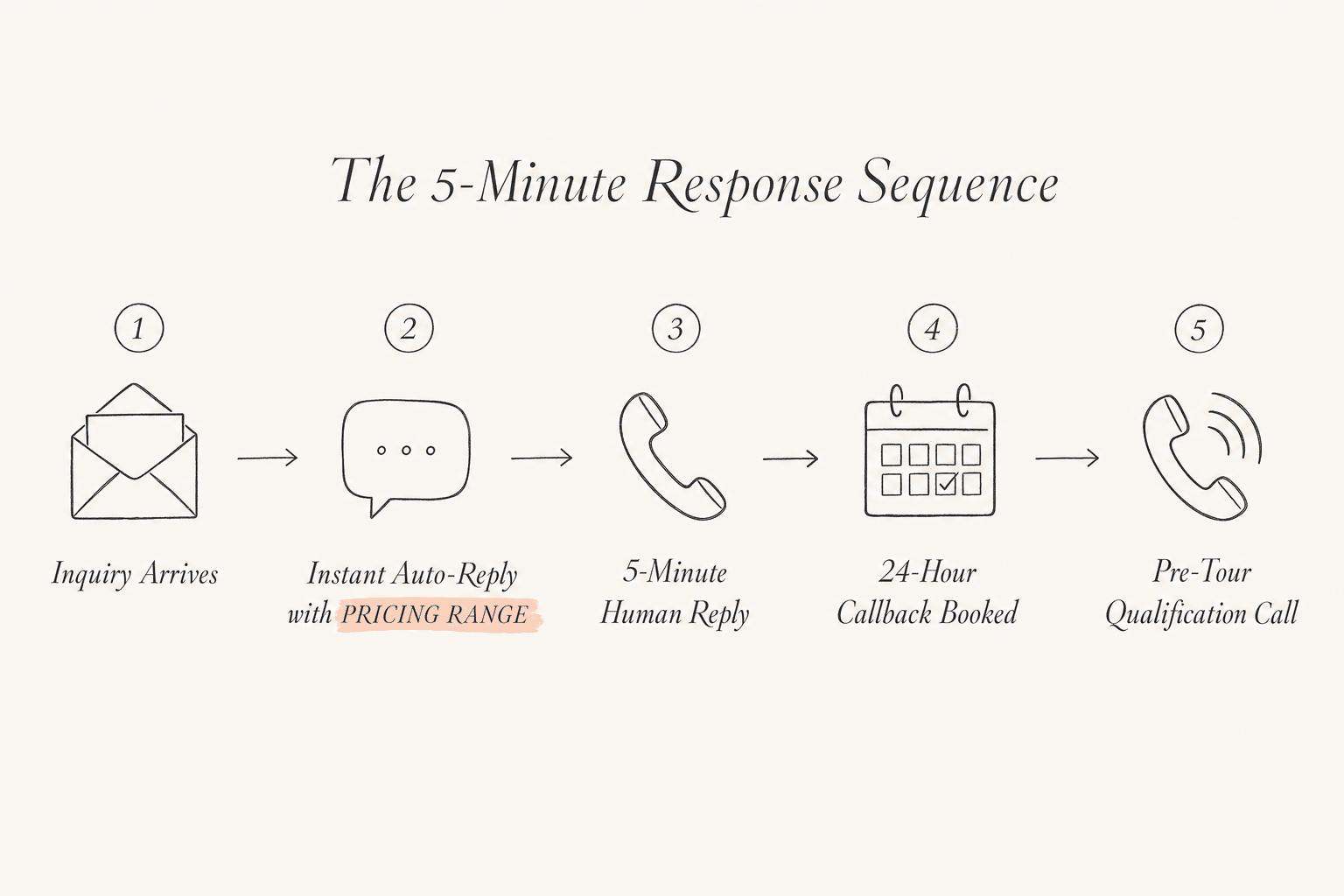
11. Respond to every inquiry within five minutes during business hours
Speed to first response is the single largest conversion variable in venue sales. Couples are inquiring at three to five venues in the same evening. The venue that responds first books the tour a disproportionate share of the time, because they get to set the timeline, the talking points, and the available dates before any competitor weighs in. Five minutes is the practical ceiling. Twenty minutes is already losing tours.
12. An auto-reply that commits to a pricing range and a 24-hour callback
The instant auto-reply most venues send is generic (“thanks, we will be in touch”) and converts almost nothing. A real auto-reply does three things: it commits to a specific pricing range up front so couples can self-qualify, it commits to a real human callback inside 24 hours, and it asks two qualifying questions (date and approximate guest count) that the couple can answer in a single sentence. Venues that put a pricing-range commitment in the inquiry auto-reply have a meaningfully higher tour-booking rate, because the couples who reply have already accepted the price.
13. A pre-tour qualification call that protects your weekend
A fifteen-minute phone call before the in-person tour does two things at once. It confirms the couple is real, has a date, has a guest count, has roughly the right budget, and is decision-ready, so you are not spending a Saturday morning on a tour that was never going to convert. And it gives the couple a chance to bond with a human voice from your venue before they walk in. The tour close rate on couples who took the pre-tour call routinely runs above 50%; the close rate on cold tours sits closer to 20%.
14. A second-touch sequence for inquiries that go quiet
Most venue follow-up stops after one or two attempts. The booked-wedding data says half the couples who eventually book did not respond to the first or second touch. A four-touch sequence over fourteen days (email, SMS, email with photos, “should we close your inquiry” final note) recovers a meaningful share of inquiries that would otherwise have aged out, at zero marketing cost.
15. An exit-recovery path for couples who toured but did not book
A couple who toured and chose somewhere else is the highest-converting “lost” audience you have. They liked you enough to come visit, and the one venue they picked instead is the only one that beat you on a specific dimension (price, date availability, a feature). Ask them why on the way out. Capture the answer. Re-contact six weeks later with the specific objection addressed: a flexible payment plan, a newly opened date, the feature you have added. Recovered tours are real bookings and the most diagnostic feedback you will get on what to fix next.
Layer 4: Amplify — Paid and Social Once Foundation Holds
Amplify is the layer most venue marketing articles start with. We put it last on purpose. Paying for inquiries before Foundation and Conversion are honest is the most expensive way to discover that your inquiry-to-tour rate is too low. Once the first three layers hold, Amplify multiplies them. Before that, it multiplies the waste.
16. Two short-form video series, on a 90-day commitment
Short-form video remains the highest-ROI organic channel for venues in 2026. The discipline that wins is consistency, not virality: pick two recurring series and ship them weekly for ninety days. A “room flip” series (empty space to fully styled reception) and a “buyer confidence” series (parking, capacity walkthrough, rain plan, what’s included) cover both the inspiration and the practical question couples need to see before they inquire.
17. Meta ads that mirror search intent, not interest categories
Most venue Meta ads target “engaged” as an interest and lose. What works is a lookalike audience built from your booked couples (one to two percent lookalike inside your service radius), creative that addresses one of the four decision questions from Layer 1 directly (rain plan, included vendors, pricing range, capacity), and a single clear call to action that matches the couple’s stage (download the pricing guide for cold traffic, book a tour for warm).
18. Retargeting couples who visited the pricing or tour pages
Retargeting is the highest-converting paid placement a venue runs. A couple who reached your pricing page and did not inquire is exponentially more likely to convert with a second touch than a cold engaged audience. Run a small retargeting campaign on Meta and Google with creative that addresses the most common reason couples bounce from pricing (the specific date availability they were checking, a payment plan option, the included items they may have missed).
19. Partner co-marketing with one or two adjacent vendors
A planner and a photographer are not your competitors and they share an audience with you. A joint email to each other’s couple list (“our three favorite venues for outdoor ceremonies,” with you in the slot, in exchange for the same favor) generates more qualified inquiries in a single send than most Meta campaigns generate in a month. The audience trusts the recommender; the inquiry comes in pre-warmed.
20. Seasonal campaigns tied to engagement windows
Roughly forty percent of engagements happen between Thanksgiving and Valentine’s Day. The marketing window that follows runs from late December through March, when couples are actively shortlisting venues. Plan a concentrated campaign across paid, content, GBP posts, and partner outreach for that window every year. The off-season is for building Foundation; the engagement window is for harvesting Demand.
Where Directories (The Knot, WeddingWire, Zola) Actually Fit
This is the layer most venue owners spend money on first and ask the hardest questions about. The honest answer is that aggregator directory listings can have a place in Layer 4 (Amplify) for a venue with a healthy Foundation and a strong Conversion rate. They are a multiplier on top of a system that already works, not a substitute for the system.
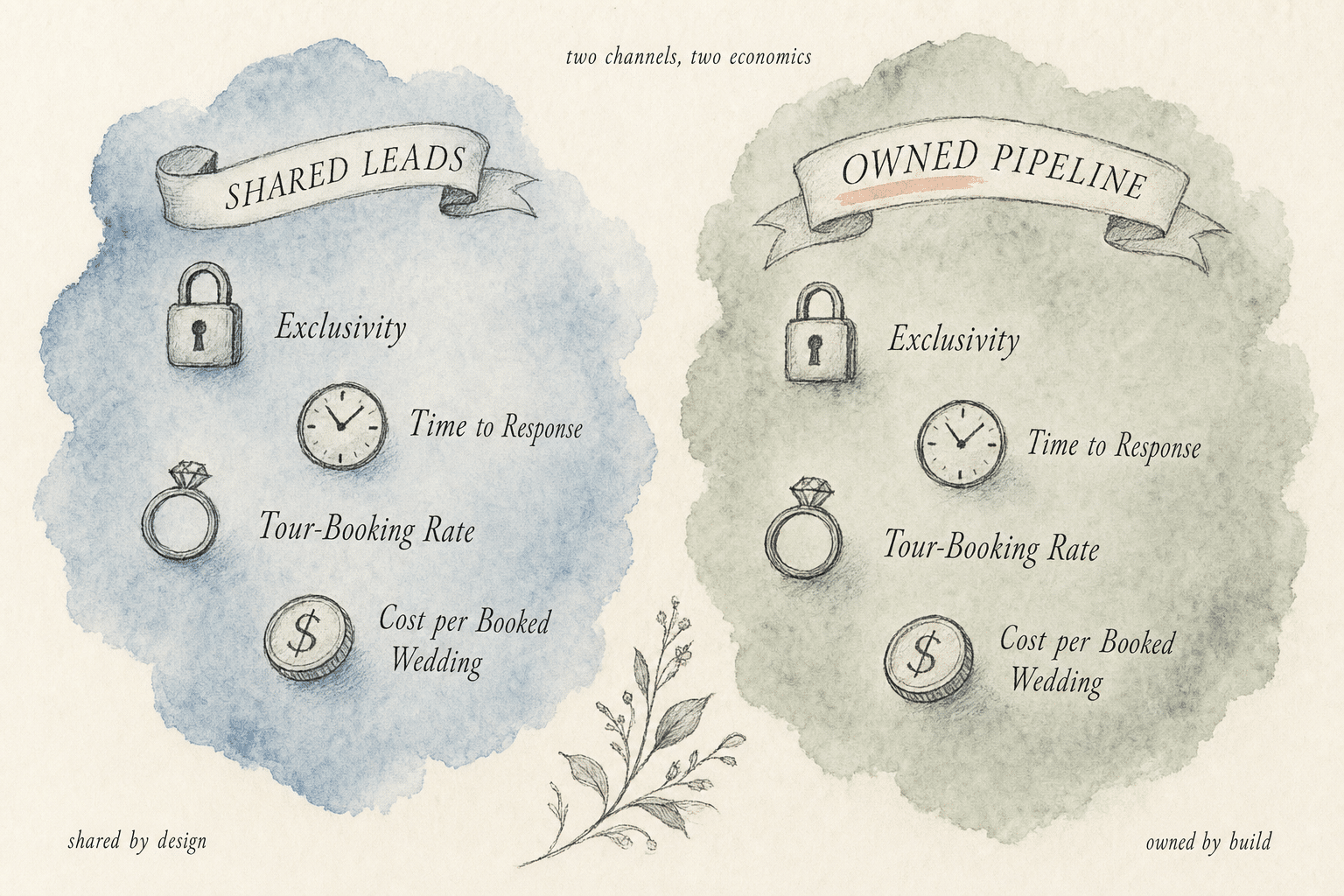
The structural reason is that the aggregator economics share your couple with three to seven competing venues by design. Even a great listing is fighting that ratio. Venues that lean on aggregators as their primary channel typically run a five to ten percent inquiry-to-tour rate on those couples, compared with twenty to thirty percent on couples from their own SEO, referrals, and direct search. The same couple is worth roughly four times more when they land first on your own pipeline.
If you are evaluating whether to renew an annual Knot or WeddingWire contract, we walk through the math and the alternatives in two companion guides: The Knot alternatives for wedding venues and how much The Knot actually costs vendors.
How to Sequence This: A 90-Day Plan
The fastest path through the system if you are starting from “we have a website and a Knot listing and not enough bookings”:
- Days 1 to 30 — Foundation. Pricing range on the site, GBP claimed and complete with monthly posts, real CRM in place with every inquiry from the last 90 days backfilled, photo library audit. No new ad spend yet.
- Days 15 to 60 — Conversion. Five-minute response standard (route to phone after hours), auto-reply rewritten with pricing range and qualifying questions, pre-tour call added to the booking flow, four-touch follow-up sequence written and active.
- Days 30 to 60 — Demand. Local-SEO page audit, three decision-moment blog posts written (rain plan, included vendors, pricing transparency), referral conversation with two planners and two photographers, GBP posting cadence held.
- Days 60 to 90 — Amplify. One short-form video series live, one Meta campaign live to lookalike audience with retargeting, partner co-marketing send scheduled. Aggregator spend reviewed against the now-honest inquiry-to-tour rate.
If you would like to see the full version of this system applied to a venue like yours, the venue marketing pillar page walks through the connected playbook, and our companion guides cover the written marketing plan and real venue examples in depth.
What is the most important wedding venue marketing idea to start with?
Speed of response to new inquiries. A five-minute response window during business hours moves the inquiry-to-tour rate more than any individual marketing channel, because the couple is comparing three to five venues in the same evening and the first responsive venue gets to set the agenda.
Should I list my venue on The Knot or WeddingWire?
Aggregator listings can sit inside the Amplify layer for a venue whose Foundation and Conversion are healthy, where the aggregator inquiry is one channel among several. They do not substitute for owning your demand. Couples coming from aggregators typically convert at one-third to one-half the rate of couples coming from direct SEO, referrals, or branded search, because the same couple is being shared with competing venues by design.
How long does a wedding venue marketing system take to show results?
Conversion changes (response time, auto-reply, pre-tour call) show up in the inquiry-to-tour rate within thirty days because they act on the inquiries you are already receiving. Demand work (local SEO, content, referrals) takes ninety to one hundred eighty days to compound. Foundation is a one-time fix that everything else depends on.
How much should an independent wedding venue spend on marketing?
The honest answer is that a venue with an unfixed Conversion rate should spend nothing on Amplify and everything on Conversion and Foundation, because paid spend on a broken pipeline is the most expensive form of diagnosis. Once Conversion is above twenty percent and the response standard is held, paid Amplify in the range of two to five percent of expected wedding revenue is a reasonable starting band, allocated mostly to retargeting and lookalike-audience Meta and to the engagement window months.
What is the best way to promote a wedding venue with a small budget?
Concentrate on the layers that do not require ad spend: a complete Google Business Profile with weekly posts, two or three decision-moment blog posts written on your own experience, a planner and photographer referral conversation, and a tight Conversion layer (five-minute response, real auto-reply, pre-tour call). Combined, those produce more booked tours than most paid campaigns at this venue stage.
Why isn’t my wedding venue showing up in Google searches?
The three most common reasons in this order: the Google Business Profile is incomplete or has the wrong primary category; the website does not have a page that matches how couples actually search (a single homepage cannot rank for every neighborhood and capacity combination); and reviews are stale (more than twelve months old) which depresses local-pack ranking even when the listing is otherwise complete.